The Cultural Heritage of Gilding

Gold leaf has been used to embellish objects serving significant social and cultural purposes for thousands of years. Foremost among this history are religious traditions involving gold. A plethora of gilded devotional objects and architectural elements were used in medieval Western religions, relying on the brilliant qualities of gold to signify the presence of the divine and to convey an aura of reverence.  Some of these, such as miniature icons and charms, were portable, while others, such as wall murals, carvings and spires, remained stationary. One example of a large architectural project is the Dome of the Rock, an Islamic shrine in Jerusalem. A landmark for Muslims and Judeo-Christians alike, the central dome is covered in gold.

The Dome of the Rock is embellished in mosaic patterns and gold. When the dome was refurbished in 1993, 80 kilograms of gold were required to complete the project. (image courtesy of The Metropolitan Museum of Art)

Eastern religions have also been known to employ gold as a signifier and a narrative aid. In Thailand, statues of the Buddha are often gilded to literally convey religious text, which describes the spiritual teacher’s golden complexion. Buddhist visitors to a temple can show their devotion to the faith by applying their own piece of gold to a statue. Other times, Buddhist religious scripts are written in gold lettering.

Figure of the Buddha Amida seated on a lotus pedestal, made of lacquered and gilded wood.From Dairenji Temple, Osaka, Japan, mid 18th century. (image courtesy of The British Museum)
Figure of the Buddha Amida seated on a lotus pedestal, made of lacquered and gilded wood. From Dairenji Temple, Osaka, Japan, mid 18th century. (image courtesy of The British Museum)

In a secular context, gold symbolizes power. The material is seen in the Far East on objects including Chinese porcelain, Korean beads, Japanese screens, Indian armlets and Middle Eastern coinage. In the West, we have shoes, Italian armor, English bodkin cases, French brooches and dozens of other treasures befitting each national tradition. Teddy Roosevelt’s “Great White Fleet” boasted gold scrollwork on the bows of each of 16 functioning naval battleships.

Nowadays, visitors to the U.S. Capitol and other official buildings are greeted with an awe-inspiring onslaught of gilded ceilings, frames and column details. Many of the frames received conservation treatment from Lowy’s master gilder, R. Wayne Reynolds. Curators, art lovers and high profile clients have trusted Lowy Frame & Restoring Co. for over a century.

Featured Frame of the Week!

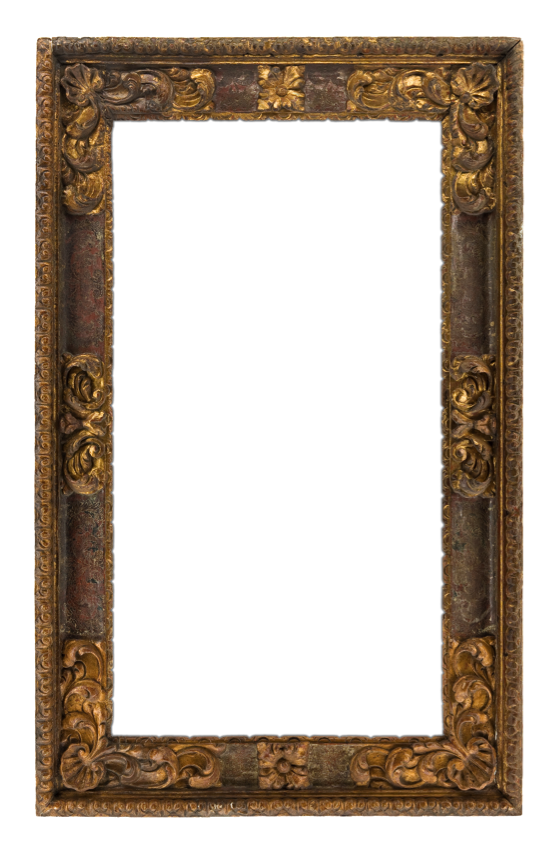
This week’s featured frame is an exceptional 17th century Spanish Charles II-style frame embellished with carvings, gold, and polychrome panel. The design features extended corners with scrolling acanthus leaf carvings, flower-head and leaf carvings, and panels with intricate sgraffito and faux-leather punchwork.

120712

Spanish frames from this time were known for their bold braggadocio, due partly to the emerging influences of Baroque art and visual culture from Spanish colonies including Mexico, Peru and Chile. Old master portraits, such as the below painting of Don Pedro de Barberana by Diego Velázquez, are likely candidates for the energetic and often colorful frames of this period, though later Spanish artists such as Picasso, Dali and Miro also admired the style. These modern masters frequently created abstract and surrealist works to be housed within a textured, engaging frame, displaying the change in artistic styles and techniques to stunning effect. Such diverse aesthetic appeal testifies to the joy to be found in these ornate creations, which invite the viewer for an intimate experience of both the framed artwork and the frame itself.

Diego Velázquez, Portrait of Don Pedro de Barberana (image courtesy of Frameworks by Paul Mitchell and Lynn Roberts)

Guide to Gilding: Preparing the Surface

Lowy’s antique and reproduction frames represent various historical periods from the 15th through 20th centuries. The process of creating a gilded reproduction frame starts with the entire frame designed on paper, which is then carved in wood. Wood is one of the most common and useful substrates for gilding because it is stable over time and because it is true to traditional techniques. In accordance with fashion, culture and custom, frame makers have worked in a variety of woods such as pine, poplar, oak and limewood. In the 19th century, the newly developed material called composition, a thick moldable mix of rabbit skin glue, whiting, linseed oil and rosin, gained popularity for its ability to mass produce ornament. Composition made it possible to make complex frames with many different designs because the ornament could be cast into molds and applied to the frame, instead of being hand carved.

If you have trouble seeing the above images, please click the pop-out button at the bottom right of the slideshow.

Even when elegantly carved, bare wood is irregular and must be smoothed before applying gold. First, we apply a layer of rabbit skin glue to ensure that bonds will form properly. Then, we brush on 10-12 coats of warm liquid gesso, a protective covering typically made from calcium carbonate or calcium sulfate, water, rabbit-skin glue and sometimes linseed oil. After the gesso dries, it is sanded. Next, we apply layers of traditional bole, a fine particle clay also mixed with rabbit skin glue. The bole, which is usually yellow, red or grey, will over time start to show its color through the gilding due to abrasion of the finish. When applying these base layers, gilders must balance even coverage with maintaining detail, keeping the original design intact. Sometimes this requires that we recut the design by carving back into the gesso layer to redefine or augment the ornamentation.

In this 17th century Italian frame, red clay is visible through the finish.

Lowy has facilities for antique frame reproduction, carving and gilding. That’s one of the reasons why we have been sought out for frame fabrication and restoration projects for such a long list of venues, ranging from government buildings to private collections and public exhibitions. If you would like more information, please ask! And stay tuned for the rest of our series on gilding.

Featured Frame of the Week!

This week’s featured frame is an American gilt composition frame, featuring a leaf-and‐berry top and a panel of intermittent rosettes connected by a geometric stylized design, created by the Philadelphia- based firm of G. Sauter. This piece exemplifies the artistic interest in stylized, ornamental designs and embellished surfaces seen during the late 19th century’s Aesthetic Movement.

Composition frames had grown popular throughout the century because they were easier to manufacture and worked with a variety of designs. The geometric motifs in this frame display the influence of architect and celebrated frame-maker Stanford White, who incorporated architectural design motifs and used European and Asian ornamental forms for inspiration. Most of the time, White designed a frame specifically for an artist or an architectural design project, such as in his collaborations with the American painter Thomas Wilmer Dewing.

This Stanford White frame complements Abbott Thayer’s Angel with its complex tabernacle design (image courtesy of Smithsonian American Art Museum)

With our vast collection of antique American frames and our personal knowledge of the period’s history, Lowy leads the way in preserving the frames that shaped 19th century American art.

The Evolution of Gilding

Gold, one of the most malleable and permanently shiny metals on earth, has been worked by artists and creators since at least the sixth millennium B.C.E. A function of the material’s stable chemical structure and geological rarity, gold has secured statuses ranging from an embodiment of luxury to a protector of sensitive industrial components.

one of Lowy's many spectacular gold frames

Alas! Because gold is soft, rare and expensive, objects made entirely of gold are extraordinary and uncommon. The 500-year-old process of gilding was developed to produce decorative arts objects that give the illusion of solid gold. At Lowy we continue the tradition by starting with gold that has been hammered into very thin sheets known as gold leaf. And we do mean thin — 1/250,000″ or less! Such thin material is possible because gold has a uniquely fluid, and therefore very strong, bonding structure. The gold leaf is most commonly applied over a covered wood substrate with a glue and chalk ground. Ancient cultures such as the Egyptians and Greeks covered objects in a thick layer of gold before gold leaf was invented.

Lowy’s master gilder, R. Wayne Reynolds, demonstrates the flexibility of gold leaf to a panel of admirers

Check back at The Lowy Blog over the next several weeks for our snapshot into the rest of the process. With a uniquely long history and deep knowledge about this traditional craft, Lowy is your master for magnificent gilded frames.

Featured Frame of the Week!

This week’s frame is a fantastic early 18th century French Régence frame with demi centers and corners. Master artisans spent many months designing, carving and gilding these by hand.

18th century frame

A frame such as this would have been used on French paintings of the period, such as Louis Le Nain’s Peasants Taking a Meal.

Le Nain Peasant's Meal
Louis Le Nain, Peasants Taking a Meal (image courtesy of Christopher L.C.E. Witcombe at Sweet Briar College, http://www.witcombe.sbc.edu)

During the 19th century, dealers often used ornate frames of this type to decorate French Impressionist paintings, balancing the picture’s sensuous and painterly expressiveness with the frame’s structured embellishment and intricate patterning.

Short History of Cobalt Blue

Also known as Thénard’s blue, cobalt blue has appeared on objects, frescos, ceramics and glass since antiquity. Painters and painting enthusiasts today know it as a distinctive and warm yet deep complement to ultramarine, phthalo, manganese and other blues.

The pigment’s nickname comes from chemist Louis Jacques Thénard, who discovered a stable version of the material in 1802. Before that time, artists using cobalt worked with the appropriately named Smalt, an unstable pigment derived from cobalt ore and developed during the 16th century. Little is known about the production behind earlier appearances of the color.

Independent of process, cobalt blue has been popular among figurative and landscape painters such as Vincent Van Gogh, Maxfield Parrish and Giambattista Tiepolo. Contemporary installation artist Eve Laramee even covered the floor of an entire room with Cobalt-colored glass in her piece Requiem for a Blue Field. Beyond fine art, the color is used in ophthalmology, both as a filter in ophthalmoscopes and as a dye used to detect corneal ulcers and scratches.

Vincent Van Gogh’s The Yellow House has received notice from critics about its use of Cobalt. (image courtesy of artnewsblog.com)

What do you think of Cobalt blue? Tell us in the comments.

Picasso’s Frame Preference

Most art enthusiasts know that Pablo Picasso revolutionized the painted image, inaugurated Modernism and created a taste for geometric forms, bright colors and bold lines. True devotees are familiar with the artist’s preference for antique frames.

Picasso thought deeply about the frames for his pictures, preferring the antique Spanish variety to numerous contemporary alternatives. Most often these antique wooden frames are carved and sculptural, with compositions that blend ancient curvilinear and geometric shapes such as rosettes, interlocking leaf patterns and ridged seams. They are an enticing finish rather than an enclosing box.

Image
This framed Picasso portrait shows how the artist liked to see his work displayed.

Picasso’s preference for antique frames should not surprise us, for he was a truly multidimensional artist also known for the wide range of his artistic pursuits. Outside of painting and sculpture, his projects include four complete production designs for the Ballets Russes, designs for menus and advertisements, and book illustrations for a number of his literary friends.

Any favorite Picasso frames? Tell us in the comments!

Outside The Scream

Been hearing a lot about the top dollar seller The Scream by Edvard Munch, sold last night at Sotheby’s for almost 120M dollars? Lowy was entrusted with fitting the priceless work of art with the appropriate glazing and acid free materials, and ensuring that the frame was in top notch condition.

Featured Frame of the Week!

Today’s featured frame is small but effective.

18th century Italian

fancy top frame

3 3/4″ x 2 1/2″

2 1/8″ wide